PROGRAM OVERVIEW
No soil, Just Water 4-H Curriculum was developed by the Cooperative Extension Program at NC A&T State University as a pilot program associated with an Agri-Science initiative across the state. Lee County 4-H may be able to provide materials depending on demand. Graphing and observation opportunities post-lesson.
This lesson is approximately 1 hour and can be done virtually with kits in the student's hands. By the end, students will have a completed, seeded planter and instructions for aftercare.
If you are interested in this as a high school program let us know. Minda Daughtry, our Horticulture agent, is developing a program for use in upper-level classrooms.PROGRAM OBJECTIVES
- Increase student knowledge through hands-on learning opportunities in areas of science and math, specifically plant science by building a hydroponics planter.
- Provide experiential learning: germination, seed dissection, soil vs. water, and proper handling
- Career discovery
METHODOLOGY & EVALUATION
Experiential Learning is student-centered. It is an active learning process, which first involves youth in an activity, asks them to reflect on the activity to determine what was useful or important to remember, and then tasks youth with understanding how the information they learned applies to their lives now and in the future. This learning process is holistic and allows youth to consume, apply, and build upon life experiences. Pfeiffer and Jones’ experiential learning model is commonly used in 4-H. However, other pioneers such as Kolb provide a wealth of research that emphasizes the importance of the adult facilitator. According to Kolb, the experiential learning model allows the learner actively participate in what is learned. The facilitator’s role is to connect with the student to spark their interest and intrinsic motivation so that the student can gain, revise, or enhance their life skills. The facilitator plays multiple roles during this process: balancing the attention of the learner, engaging with the subject matter, and creating a safe and holistic learning environment.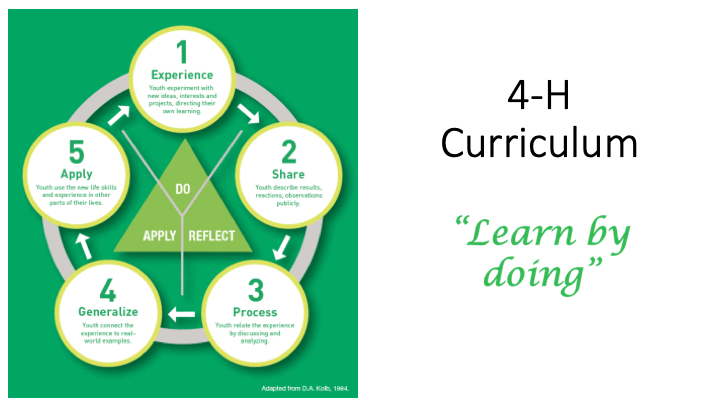
Evaluations are important for impact reporting. There will be a brief pre and post-survey to measure results.