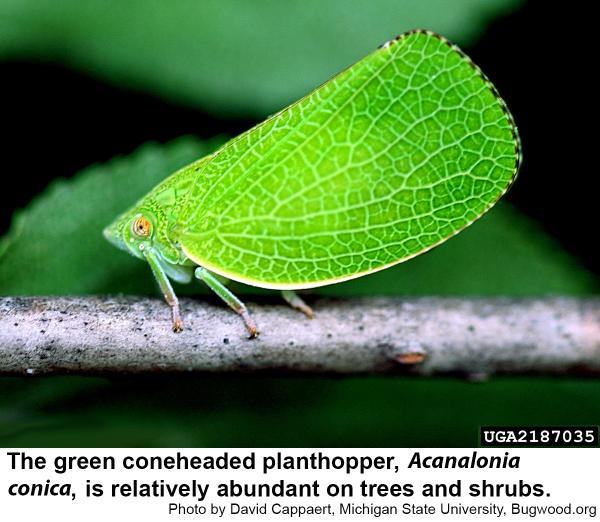
So what do you think the answer to the question is? If you guessed that it is something that hops from plant to plant, you've earned yourself a sticker. Sometimes the common name and description are nothing short of logic. Other times, not so much. These tiny creatures are usually no more than 1/4 inch long and their even smaller nymphs are emerging now. You may not notice the insect itself, but the cottony fluff surrounding it may be your first clue of its presence.
The most common planthopper in North Carolina is the citrus flatid planthopper (Metcalfa pruinosa). Adults are a dark, bluish-black, but with a white waxy bloom that makes them appear white or bluish-white. The eyes are red. Nymphs are a pale green, again with the red eyes and are covered in a thick, fluffy white secretion that also covers the stem of plants. The snowy planthopper (Flatormenis proxima), also a flatid species, is found in North Carolina and is snowy white in appearance.
Another type of planthopper, Acanalonia conica, most notably called the green coneheaded planthopper has many of the same traits. Conehead? Really, y'all. I'm not making this stuff up. Do you think they consume mass quantities? The nymphs of this insect are a mottled gray and are also covered in a white, fluffy wax as is the flatid type. When they develop into adults, they turn a lovely shade of green.
The biology of both types of planthoppers are quite similar. Both feed on numerous trees, shrubs and ornamental herbs. They overwinter as eggs under the bark of plants. The nymphs emerge in spring and summer and their waxy secretions cover them to help protect them from predators which include wasps, spiders and certain mites. Nymphs of flatid and acanalonid have been observed feeding together in mixed populations. Adults appear during summer, usually in late June through