The wheel bug (Arilus Cristatus) is a large, brown to gray bug with rusty brown antennae and a dark, shining area of the wings over the rear of the body. It has a raised semi-circular crest that resembles a half "cogwheel" on its thorax which distinguishes it from other insects. It is the only species in the United States with a crest such as this. Its territory reportedly ranges from Rhode Island west to California, south to Texas and Florida. It is North Carolina's largest assassin bug and will grow up to 1⅜ inches.
Watch Out for Wheel Bugs
(Updated: May 6, 2022, 4:58 a.m.)
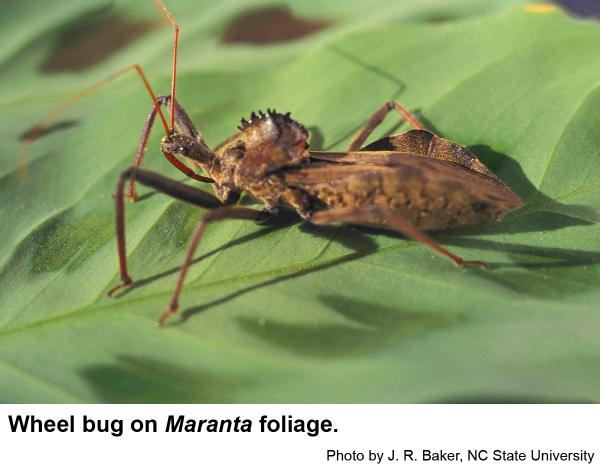
Wheel bugs are aggressive predators that feed on the imported cabbageworm, Japanese beetles, cucumber beetles, fall webworms, stink bugs, aphids and small insects. When caught, the prey is pierced and injected with a potent saliva that contains powerful enzymes that digest the tissues inside. The bug then sucks the digested liquid from the prey and leaves the shriveled remains. Wheel bugs are sometimes cannibalistic and feed on other wheel bugs. Females have been observed feeding on males after mating. Maybe he should have offered her a smoke.
The life span of the wheel bug is one generation per year. Eggs are laid in late fall. They resemble miniature brown bottles with white stoppers laid side by side in clusters of up to 182 eggs. These masses are usually located at around four feet and below on tree trunks, limbs and shrubs. The eggs overwinter and begin to hatch from April through June. Several stages of nymphs develop into adults in about three months. Younger nymphs are bright red with black marks and lack the cogwheel crest. Older nymphs are colored more like adults. Both nymphs and adults are aggressive.
For some great photos of the progression of wheel bug eggs being hatched into nymphs, check out Birth of an Assassin! by Debbie Roos, Chatham County Extension agent specializing in Sustainable and Organic Agriculture and gardener extraordinaire.
Wheel bugs are considered to be beneficial, so controls should not be necessary. However, a word of caution, wheel bugs can inflict a painful bite if carelessly handled which has been described as "much more powerful than a hornet or wasp sting". The description continues as "the initial pain is followed by numbness and the area becomes reddened and is hot to the touch". Healing time is approximately 10 days to two weeks. If they do become a nuisance, do not directly handle them but dislodge them with a brush or broom or a spray from a garden hose. For more information, visit our Wheel Bug Entomology Notes.
Wheel bugs are an important part of our ecosystem. They feed on many plant pests and their populations usually remain under control. Their presence may become more evident in the next few months so be on the lookout. If observed, take flight and don't let the wheel bugs bite.
Gail Griffin is the Extension Master Gardener℠ Volunteer with N.C. Cooperative Extension, Lee County Center.
Join our mailing list!
Enter your email address to receive updates.
Written By

More About