This article was written by Gail Griffin, Extension Master Gardener Volunteer with North Carolina Cooperative Extension in Lee County.
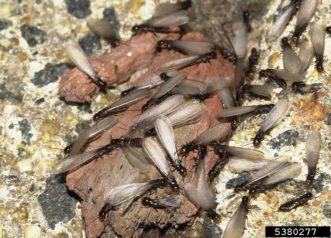
When cold weather begins to wane, we look forward to warming sunshine, leaves returning and buds swelling with renewed life. All around us wildlife is teeming, birds are seeking out their nests, bees are buzzing, butterflies fluttering, and termites are swarming. Wait. What? Yes, unfortunately this is the time of year we are reminded that termites are a part of our southern ecosystem. Late winter, when temperatures rise and especially after rainfall, mature winged adults swarm from their original nesting site in search of forming new colonies. This activity continues until September or October. Outdoors, this is a natural occurrence but if this is happening indoors, you definitely have issues.
The Eastern subterranean termite is a native species of North Carolina and one of our most common types. They live below ground and feed on woody materials like tree stumps. A single colony can forage over a 1/3 acre site. Swarming is an indication that termites are nearby. Several species of winged ants that resemble termites also swarm at this time, so correct identification is needed. Termites are not present on the soil surface, but instead travel through it. Their tunnels result in mud tubes made of soil, particles of wood and other materials. These tubes can be
found on foundation walls, floor joists and other parts of structures. If tubes are opened, live termites can be observed. If they are empty, it doesn't mean they have left the area. In fact, they can rebuild damaged tubes which is another indication that they are currently active. Termites can feed on any products containing cellulose including paper, cardboard, wood paneling, sheetrock and carpeting. They will also tunnel through plastic or foam board in order to reach a food source. If tubes are present in ceilings or in upper levels, it means there is an above ground infestation and they actually live in the building. This may suggest that there is a serious moisture problem or a leak in the structure. Areas of soft wood that are easily penetrated by a knife or screwdriver or wood that has a hollow sound when tapped may pinpoint where damage has occurred. There can be a thin, gritty grayish film on the surface of damaged material.
For preventative measures, find and eliminate any moisture problems that are present. Avoid storing debris containing wood or paper in spaces near ground level. Check around the foundation and crawl space for mud tubes. Spraying swarmers or surfaces of damaged wood will not stop the infestation or protect from future damage. The most commonly used method is a trench and treat application of termiticides around the entire foundation, interior crawl space, walls and piers. An inspection from a reputable pest management company can help determine if there is current activity. If entering into a pest control agreement, read the entire contract and learn all possible aspects and guarantees including expectations of retreatment and use of baiting systems. A list of regulations can be found under the NC Department of Agriculture and Consumer Services- Structural Pest Control and Pesticides Division.
Helpful information can be found at content.ces.ncsu.edu/tips-on-selecting-pest-control-services.
A DIY (do it yourself) approach is usually not recommended. Proper treatment is complex. Applications of termiticides in confined spaces require respirators and clothing used in handling hazardous materials. Rates could exceed one hundred gallons of chemicals depending on the depth of footings and the size of structure(s) being treated. Concrete slabs will need to be drilled in order to apply the chemicals necessary to treat the area. The Environmental Protection Agency requires manufacturers of these chemicals to prove their product is effective for five years, but if the soil is disturbed, the treatment may not linger.
Swarming termites can be a nuisance, but are a part of the natural scheme of things in the great outdoors. There is no need to panic, just be aware that we need to stay vigilant in maintaining and protecting the investment we call home.
Gail Griffin is an Extension Master Gardener Volunteer with North Carolina Cooperative Extension in Lee County.