When most folks think of fall color, their minds immediately picture the warm tones of autumn leaves—shades of burnt orange, deep red, golden yellow, and rusty brown. But if you look closely at a well-designed native landscape in October, you will see brilliant bursts of electric purple, lavender, pink, and white cutting through those warm earth tones.
These fall-blooming standouts are our native fall asters. Not only do they provide a dramatic grand finale to the gardening season, but they also serve as a vital resource for late-season pollinators. They are a refueling station for migrating monarch butterflies. These flowers provide nectar to passing insects and protein-rich pollen to bees, including the specialist aster mining bee, and beetles when everything else has run out for the season. It also serves as a host plant for a few native butterflies and moths.
The Name Game: Understanding the Taxonomy
If you haven't bought asters in a few years, you might notice a tongue-twister of a name on their plant tags at the nursery. Several years ago, botanists conducted a major taxonomic revision based on genetic research. They reclassified almost all North American native asters out of the classical genus Aster and into the genus Symphyotrichum (pronounced sim-fy-oh-TRY-kum).
Despite the complex name, these plants haven’t changed their flowers. They still produce classic, daisy-like composite flower heads with bright yellow or purple centers. Individual flowers can range from delicate quarter-inch buttons to showy blooms larger than a quarter, depending on the species.
General Growing Conditions & Care
Native asters are remarkably resilient, making them ideal candidates for Central North Carolina landscapes. Most native asters prefer full sun to light partial shade. The more sunlight they receive, the more abundant their flower display will be.
They generally thrive in moist, well-drained soils, but once established, many species exhibit impressive drought tolerance. Some species even prefer poorer soils and will often stay much sturdier and well-behaved! In rich, heavily fertilized garden soils, some taller asters can become aggressive spreaders or get a bit "floppy."
Some species can get rather tall or flop over, especially if you have been amending your soil with compost or fertilizer. To keep these tall asters compact and prevent them from falling over under the weight of autumn blooms, pinch or prune back their stems by one-third to one-half in mid-summer (June-August). The plants will reflush after the pruning in order to set flowers. This encourages dense, bushy growth and can double your bloom count come fall!
Five Native Asters to Know and Grow
Here are five outstanding species of Symphyotrichum native to North America that will bring your autumn garden to life:
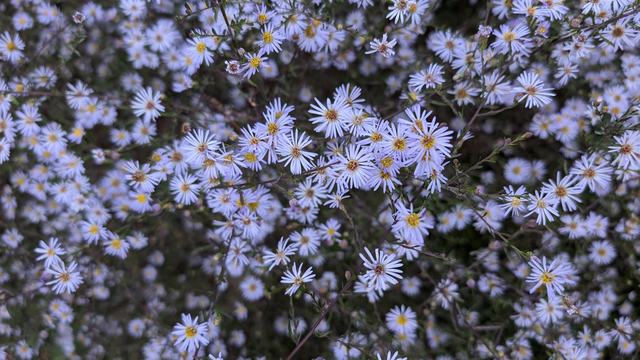
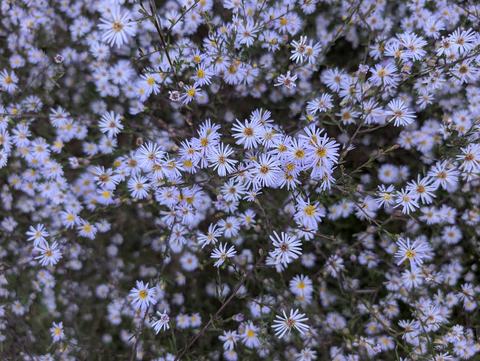
True to its common name, bushy aster forms a fine-textured, heavily branched mound covered in hundreds of tiny, dime-sized, pale blue to pinkish-white flowers really late in the fall, sometimes from Thanksgiving to Christmas. Late-season bees and flies can be found all over this plant. It isn’t going to be the star of the show, but its soft, cloud-like texture can be a great filler for perennial borders or grassland edges to take up the space in-between.
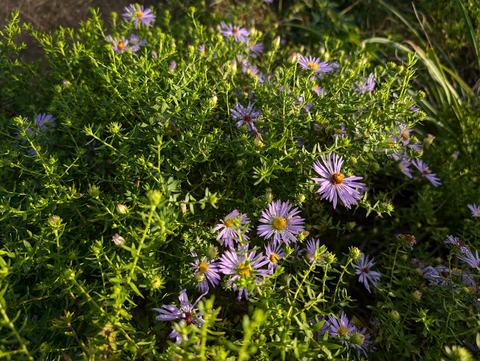
This is one of the tough-as-nails favorites for NC gardens! It features fragrant, sweet-scented foliage when crushed and forms neat, rounded mounds covered in deep sky-blue to violet flowers in late September to November, easily flowering through the first frost. There are two especially popular cultivars: 'October Skies' with its sky-blue blooms and mostly compact growth of about two feet tall; and 'Raydon's Favorite' with lavender-blue, almost pink sometimes, flowers and slightly taller, vase-like growth. A thing to note about this species and these cultivars is it can seed around. Thankfully it is easy to pull up! Don’t let its beauty fool you, it can grow in the poorest, hottest soils. It is great for retaining walls, hot sunny borders, and low-maintenance native beds.
The basal leaves of this plant feature a gentle heart-shaped pattern, but you won’t notice these once they start to flower. The arching stems hold airy sprays of small, soft blue to light purple flowers with yellow centers that mature to reddish-pink. While it’s one of the more shade-tolerant species, it can tolerate some sun in sunnier locations, especially if it is tucked under the shadow of a summer bloomer. This species extends the bloom of your garden from September through October.
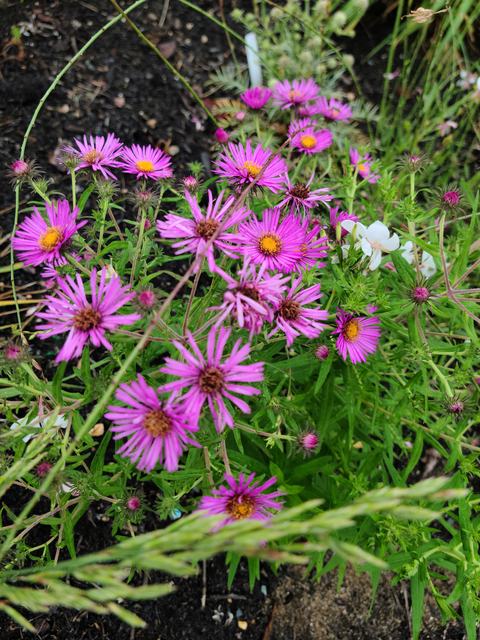
The New York aster is known for its smooth, dark green foliage and rich, intense flower colors ranging from magenta to deep violet-purple. The flowers may seem similar to the New England Aster, but the disk flowers, the ones in the middle, are much more pronounced in the New York Aster. The colors that are available to gardeners will bring a rainbow to your garden when you think it isn’t possible. These plants can get tall, especially in richer soils, so they should be in the middle to back of your garden beds. They do have a formal, upright appearance, so they can be a formal element in an otherwise wild-looking garden.
The New England aster is a stately, robust perennial growing three to five feet tall with sturdy, hairy stems and large, dramatic flowers in deep shades of purple, rose, and pink with golden-yellow centers. This species is best in the middle or back of the garden bed due to its interesting habit of dropping the leaves along its flower stem, leaving bare stems. This can make it awesome for adding a layered effect to your garden without worrying about too much competition for space. There have been some selections made of this species, and one of my favorites is 'Purple Dome', which true to its name, forms a compact, 18-inch mounding selection that explodes into a solid dome of royal purple in late September and October.
Get In Touch!
Amanda Bratcher is the horticulture agent with N.C. Cooperative Extension—Lee County Center. Have questions about native plants, fall garden prep, or perennial care? Reach out to our office at 919-775-5624 or visit our center at 2420 Tramway Road in Sanford. Find upcoming landscape design workshops and community classes on our events page!
This article originally appeared in The Sanford Herald. You can read more articles from the Herald on their website.
Resources
Extension Gardener Handbook Chapter on Native Plants
NC Extension Gardener Plant Toolbox
Symphyotrichum
Fun Profile Piece about Asters for Western PA but with great notes
Aster Mining Bee