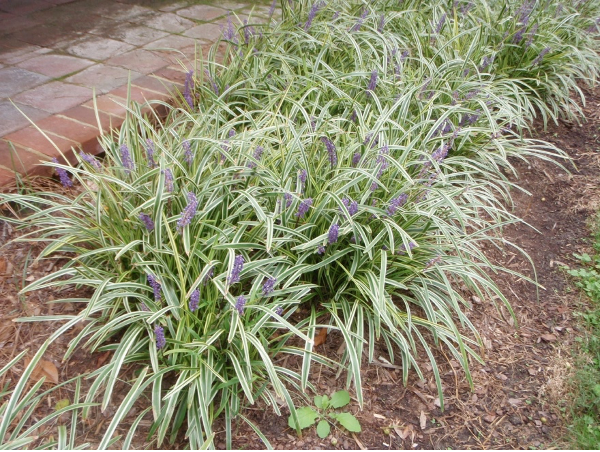
Liriope, also called lilyturf, is one of the workhorses of evergreen ground covers. It multiplies rapidly and requires very little care. It grows well throughout our area and is actually a member of the Asparagaceae (asparagus) family. Some types such as Liriope spicata, otherwise known as creeping lilyturf, spread (a lot). Others such as Liriope muscari “Varigata” have a clump-forming habit and while they expand in diameter, tend to stay where you put them. The leaves are straplike up to 18-inches long, dark green turning to bronze-green in winter, or green with white centers as in L. muscari “Varigata”. This plant grows between 6" and 10" tall. Flowers are spike-like clusters of pale violet to white, 6-parted, on elongated stems appearing in mid to late summer. The fruit is a blue-black berry, It’s mildly resistant to damage by deer and is heat, drought and highly salt-tolerant. It will grow in deep shade or full sun, sand or clay but will not take “wet feet”; it requires moist, well-drained soil.
They are light feeders and benefit from a slow-release or organic fertilizer applied in the early spring. To maintain an attractive appearance, cut back tops each February
before new growth begins. Anthracnose, leaf and crown rot, slugs, and snails are occasional problems though it is a mostly problem free plant.
One of a gardener’s challenges is to identify whether the disease will affect a plant’s long-term health and if not, whether management is necessary. Leaf and crown rot is a problem to watch for on Liriope (or lily turf) in both nursery and landscape settings. This disease is caused by the “water mold” Phytophthora palmivora. Initially, affected leaves turn yellow beginning at the base while the tips of the leaves remain green. The base of these leaves then develops a watery rot and turns brown.
Eventually the entire leaf becomes yellow with a brown, rotted base. This disease develops rapidly in late spring and early summer as temperatures increase and we experience periods of sustained rainfall. However, overhead irrigation can be a replacement for rainfall.
The disease continues to develop through early fall and finally declines during the cool period from late fall to early spring. Once brought into the landscape, P. palmivora can endure for a long time, and because it has a wide host range, it can become a problem on other plants as well.
Using disease-free plants is the best means of controlling this disease. It’s important to avoid creating conditions that are favorable to disease development, such as overcrowding and overwatering. Care and maintenance practices that promote good drainage and rapid drying should be used as well.
Recognize when a laboratory diagnosis for a plant problem is needed. The Plant Disease and Insect Clinic, operated by the NC State University Department of Entomology and Plant Pathology, diagnoses plant and insect problems for farmers, growers, landscapers, homeowners, and gardeners. In consultation with expert faculty, they recommend ways to treat or prevent the problems they diagnose. They work in partnership with the North Carolina Cooperative Extension Service, whose local county personnel can help identify common problems as well as assist you in properly collecting and submitting a sample to the PDIC.
Minda Daughtry is the Horticulture Agent for North Carolina Cooperative Extension in Lee County