This article was written by Gail Griffin, Extension Master Gardener Volunteer in Lee County.
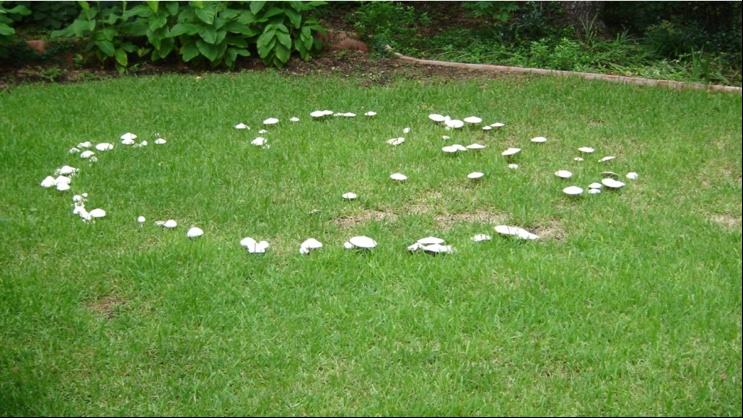
Did the fairies come and dance on your lawn last night? If so, chances are you'll find out soon enough. Fairy ring is a fungal disease of turfgrasses without prejudice. It affects cool season and warm season grasses. It is caused by fungi that feed on decaying plant tissues located in the soil.
Symptoms of fairy ring are most likely to develop between spring and fall. The disease is usually noticed in rings or arcs that can initially be only a few inches in diameter. These tend to grow in size year after year and can spread to five and ten
yards in width. There are three types of fairy ring and all are classified by their symptoms. Type I symptoms are a ring of brown, wilted, dead grass that forms a layer that prevents water from soaking into the soil. Type II usually has a ring of dark green grass compared to surrounding turf and is a result of nitrogen being released from organic matter beneath the soil. Type III symptoms are a ring of mushrooms or puffballs. Types I and II are generally associated with hot, dry weather. Type II can also be tied to scalping or mowing turf too low. Type III is most noticeable during wet conditions. Sometimes several different symptoms may occur at the same time or may change throughout the season.
Some fungi that cause fairy ring are from decaying wood and tree roots left underground. Thatch builds up in turf and prevents water and nutrients from penetrating the soil and reaching the roots. As a result, turf begins to die. The disease will tend to spread under dry conditions. Other fungi can be introduced by the addition of organic matter from contaminated soil or by water or by wind-blown spores.
To help prevent fairy ring, remove tree stumps and roots and woody materials from the lawn area before seeding or laying sod. This will help limit the amount of organic matter on which the fungus feeds. Try to reduce the amount of thatch buildup in turf. Aeration will help break up the soil and reduce compaction to allow water to reach the root zone. A soil sample will help determine if your site needs nitrogen or iron, especially for Type II symptoms. Extra irrigation may be necessary if drought conditions are present. Try to avoid extreme soil conditions as in excess amounts of nitrogen or too much or too little water. Fungicides alone cannot control fairy ring but may be more successful if used in conjunction with cultural methods like thatch removal. They are more useful as a preventative measure than a curative one. Some turf will not tolerate certain fungicides, so check with your local extension office for recommendations. For
more information, go to turffiles.ncsu.edu/diseases-in-turf/fairy-ring-in-turf/
For turf officianadoes and for us regular folk that just like our lawns, fairy ring can be a real nuisance. Sometimes knowledge, diligence and good gardening practices are our only defense. Darn those fairies.
Gail Griffin is an Extension Master Gardener Volunteer with North Carolina Cooperative Extension in Lee County.