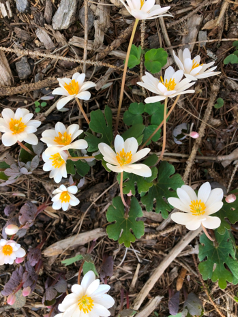
After the holidays come and go, we will all need something beautiful and inspiring to look forward to. Belonging to the Poppy family, Sanguinaria canadensis, otherwise known as the wildflower Bloodroot, is just the thing.
Beginning in March you will see the whitest-white in a flower petal that you have ever seen. It just draws your vision right into it. The flowers are solitary with 8-12 petals. When the flower is fully developed, it is about 1-1.5 inches across and appears to form a square shape. It only grows about 3-6 inches tall and you really have to look for it in rich, moist, shaded to partially shaded woods.
Look first for the leaves – or I should say “leaf”. Bloodroot has a single circular leaf with 5-8 lobes like the fingers of a hand.
It’s called Bloodroot from the bright orange-red sap in the thick rootstock. While the red sap was used for dye for baskets, clothing, and paint, as well as an insect repellent it has a serious self-defense mechanism in the roots – high toxicity from Isoquinoline alkaloids, so look but don’t interfere with the roots. As a native perennial wildflower it spreads by a rhizome (underground, horizontal stem). The native variety also forms an elongated capsule (fruit) with a seed. The fruits are green pods with brown seeds that become available April-May. There is a cultivar, 'Multiplex', that is double-flowered and does not produce a seed. This plant makes for good seasonal groundcover.
It doesn’t get seriously bothered by insects, disease, or other problems so if you have moist shade on your property it’s a great addition to the natural landscape. It’s also a great pollinator plant attracting bees and songbirds. If you don’t have woodlands on your own property, we are fortunate to have this beautiful flower on the Thoreau Trail at San-Lee Park.
Minda Daughtry is the Horticulture Agent with North Carolina Cooperative Extension in Lee County.