The Commerce Department of the Federal Government provides weather data through NOAA, the National Oceanic and Atmospheric Administration, and the National Weather Service. Weather affects every aspect of human endeavor, especially commerce, nationally and internationally. Transportation, food supplies, international trade, and health are all affected by weather. So, while the Commerce Department might seem an odd place to house scientific weather agencies, businesses must plan for weather just as much as farmers and gardeners.
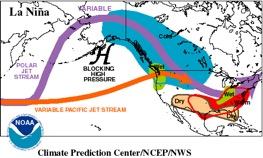
We have been hearing references in weather reports about “La Niña” having an impact on weather in many places. So, what is La Niña? According to NOAA, La Niña is the cooler half of ENSO – El Niño Southern Oscillation, a weather pattern that impacts temperature and precipitation all over the globe. It describes the oscillation of warmer and cooler waters across the equatorial Pacific Ocean. Trade winds are equatorial winds going from east to west. In the Pacific, the winds go from roughly Peru to Indonesia affecting and affected by the ocean currents. During La Niña these winds increase in strength pushing the ocean westward and moving surface waters toward Indonesia actually causing ocean levels to rise there. At the same time, the water level is lower in the eastern Pacific. The lower levels in the eastern Pacific allow the cooler sub-surface waters to rise reducing the surface water temperatures in the eastern Pacific. The Pacific jet stream which comes out of Japan heading east is pushed northward toward the Pacific Northwest in contrast to a neutral ENSO or El Niño event. In addition, warmer air rises more in the central Pacific causing a high pressure to settle in the Gulf of Alaska. The high pressure moves the polar jet stream around it, leaving cooler air over western Canada, the north central plains, and the Northeast. At the same time, that polar jet stream blocks storms coming from the Pacific resulting in wetter winters in the Pacific Northwest. A high pressure mass forms over the southeast causing the jet stream to slide south west across the central US and then turn north. This keeps more precipitation in the northeast while leaving the southern half of the US with a drier, warmer air mass. Bottom line, the Northwest and Northeast have wetter weather while the Southeast can experience drought-like conditions.
Another impact of La Niña is to increase hurricane activity in the north Atlantic because the strong trade winds reduce the wind shear over the sub-tropical Atlantic where the hurricanes form off Africa. This may have had an impact on the formation of hurricanes this fall which brought us