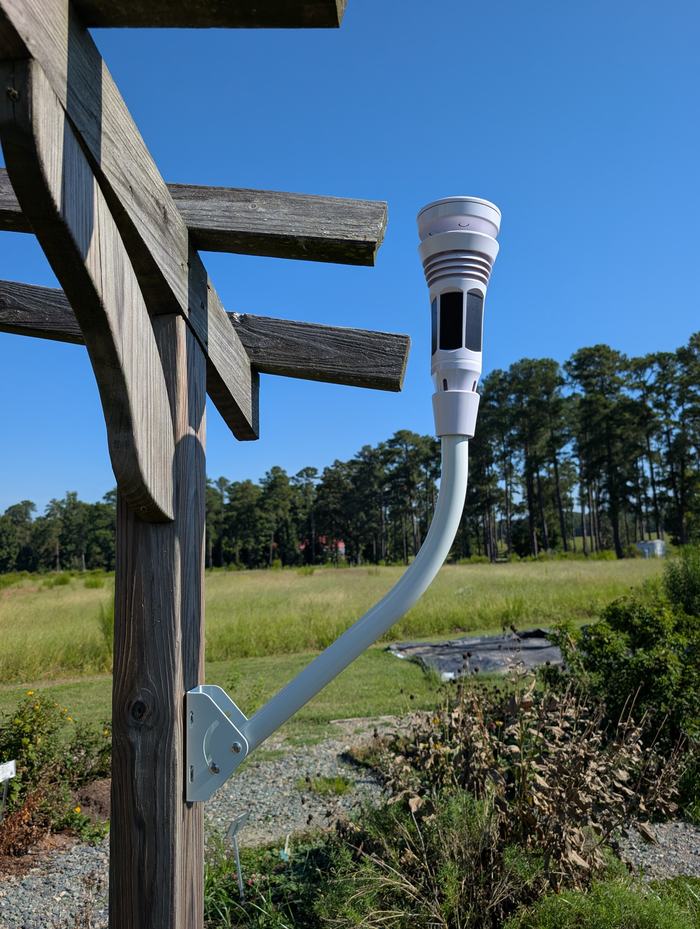
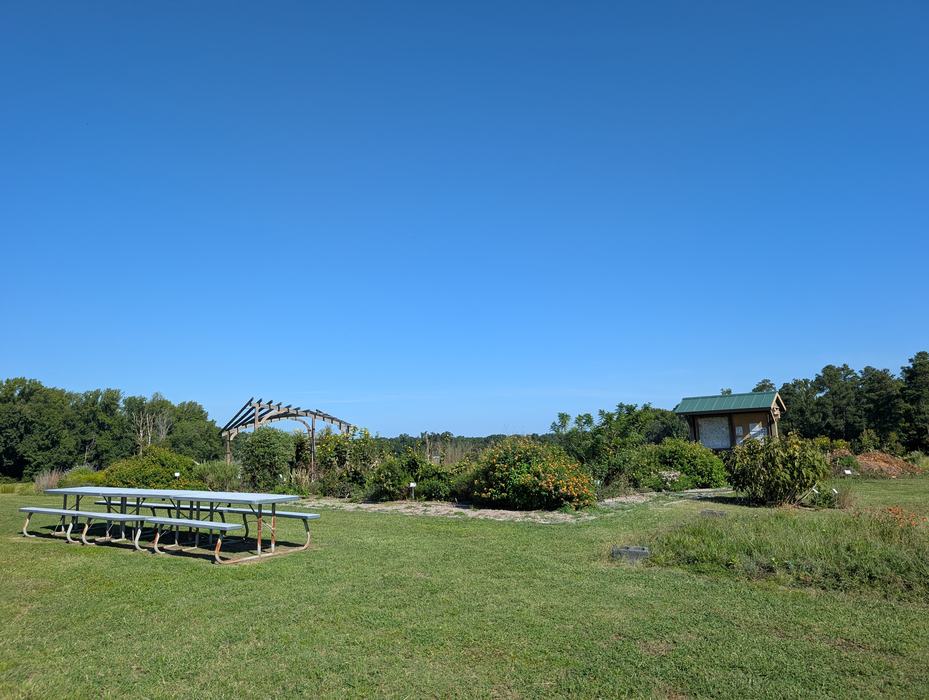
I am thrilled to announce that the N.C. Cooperative Extension—Lee County Center now houses a research-grade weather station right in our Pollinator Haven Garden behind the McSwain Extension Center on Tramway Road!
Until now, public weather data for Lee County has been sparse. When weather is reported locally, forecasts and rain tallies usually rely on the automated station at the Raleigh Executive Jetport in the Deep River/Moncure area. But if you live in Broadway, Lemon Springs, Greenwood, or the Pocket, you already know that weather on the northern end of the county rarely matches what is happening in your backyard!
Why Location & Soil Matter for Weather Data
Why talk about soils when introducing a weather station? Because geography, soil type, and weather are deeply connected.
The McSwain Extension Center on Tramway Road sits directly along a natural geological boundary. As soon as you cross US-1 to the west, you enter the heavier clay-loam soils of the Piedmont. Travel just south of Tramway Road, and you rapidly transition into the deep, porous sands of the Sandhills.
Sandy soils drain rapidly and bake under summer heat, while clay soils hold onto moisture and heat up much more slowly. Having a research-grade weather station positioned right on this transitional boundary gives us an accurate look at how ambient heat, rain, and solar energy interact with our distinct local microclimates.
Weather vs. Climate: Tracking the Big Picture
This year has brought relentless summer challenges: extreme heatwaves, prolonged dry spells, and high nighttime temperatures that refuse to drop. All of these daily events contribute to our long-term climate picture. Weather is a snapshot in time—what is happening in your garden right at this moment (e.g., an afternoon thunderstorm or a 95°F heat spike); while climate is the long-term trend of weather patterns over decades.
As our climate shifts, having hyper-local data allows us to move from guesswork to precision management. Instead of wondering when to put up shade cloth or if a pop-up shower delivered enough water to turn off the irrigation, we can monitor exact conditions in real time.
What Nine Data Points Does Our Station Track?
Our new station records nine critical environmental parameters, each offering practical insights for home gardeners, market growers, and commercial farmers alike:
- Air Temperature (°F): Governs seed germination, plant growth rates, and thermal stress. Prolonged high temperatures—especially when warm nights prevent plants from resting—force crops like tomatoes to abort blossoms. When high heat pairs with intense sunlight, it breaks down a plant's internal cooling mechanisms, leaving foliage vulnerable to sunburn.
- Relative Humidity (%): High humidity combined with heat creates prime conditions for fungal pathogens like powdery mildew, Cercospora, and leaf blights. Tracking humidity helps growers time sprays effectively and avoid late-day overhead watering when foliage cannot dry before sunset.
- Atmospheric Pressure (inHg): Drops in barometric pressure signal approaching storm fronts or sudden weather shifts, giving you early warning to secure shade structures, stake tall perennials, or harvest ripe produce before heavy weather hits.
- Lightning Strikes: Beyond alerting you when to take shelter indoors, lightning breaks strong atmospheric nitrogen bonds. This converts nitrogen gas into a water-soluble form, delivering a free, natural fertilizer boost with the falling rain!
- Wind Speed & Direction: Essential for deciding when it is safe to apply liquid fertilizers or pesticide sprays without off-target drift. Wind also accelerates evapotranspiration, speeding up how quickly plants and soils lose moisture.
- Rainfall Duration & Amount (inches): Knowing exact rainfall depth reveals whether a storm provided a deep root-zone soak or just a light surface sprinkle, allowing you to fine-tune irrigation schedules and track rainwater harvesting reserves accurately.
- UV Index: High UV levels indicate intense solar radiation that causes sunscald on ripening peppers, tomatoes, and young trees. Tracking UV peaks helps identify when solar energy crosses the threshold into fruit and leaf damage.
- Solar Radiation (W/m²): Measures total solar energy driving photosynthesis. Most sun-loving plants reach their light saturation point at moderate light levels (800–1,200 µmol/m²/s). Peak Southern summer sun far exceeds what plants can process. When excess light energy cannot be used—especially during drought when stomata close to conserve water—it produces reactive oxygen species (ROS) that break down photosynthetic proteins. Tracking solar radiation reveals the exact threshold when deploying 30–50% shade cloth will protect yields.
- Brightness (Lux): Measures light intensity across garden microclimates. Shade plants (like ferns, hostas, and alumroot) reach light saturation at low levels (5,000–15,000 Lux) and suffer bleaching or leaf scorch when light exceeds their damage threshold (~30,000 Lux). Real-time brightness data shows when light levels cross into photoinhibition (where excess light actively damages leaves), helping you select the right plants for specific light conditions.
Public Access: Science for Everyone
The best part about this new weather station? The data belongs to the community!
Whether you are a backyard gardener deciding if you need to hand-water tonight, a teacher running a weather lesson for students, or a farmer tracking heat units, this real-time data is open and accessible to anyone. We will be using these readings to fine-tune our management of the Pollinator Haven Garden, run demonstration trials on shade cloth and water conservation, and share timely alerts with the public. You can view the data anytime here.
Get In Touch
Amanda Bratcher is the horticulture agent with N.C. Cooperative Extension—Lee County Center. Have questions about microclimates, vegetable gardening, or reading weather data? Reach out to our office at 919-775-5624 or visit our center at 2420 Tramway Road in Sanford.
For gardening or farming information, visit our website or check out our upcoming classes on our events page.
This article originally appeared in The Sanford Herald. You can read more articles from the Herald on their website.
Resources:
Pollinator Haven Garden Weather Station Live Data
NC State Climate Office
Chapter 3 Botany from the Extension Gardening Handbook
Veggies and Herbs Made in the Shade: A Growing Season Calendar for North Florida Daniel K. Fenneman, Robert C. Hochmuth, Wanda L. Laughlin, and Sean R. McCoy
Foundational Science
Interaction between light and chilling temperature on the inhibition of photosynthesis in chilling-sensitive plants Stephen B. Powles, Joseph A. Berry, Olle Björkman
Significance of enhancement for calculations based on the action spectrum for photosynthesis K J McCree
Leaf Energy Budgets: Effects of Radiation and TemperatureJanuary 1998 Hans Lambers, The University of Western Australia; Stuart Chapin III, University of Alaska Fairbanks, Thijs L. Pons
Excellent Summary of Light Measurement Acronyms**
Photomorphogenesis Andrej A Arsovski, Anahit Galstyan, Jessica M Guseman, Jennifer L Nemhauser Arabidopsis Book 2012 Jan
Physicochemical and Environmental Plant Physiology Book • Fifth Edition • 2020 Park S. Nobel
Plant Physiology and Development Taiz, Zeiger, Møller, & Murphy**
Response of Leaf Water Potential, Stomatal Resistance, and Leaf Rolling to Water Stress John C O'Toole, Rolando T Cruz
Nonphotochemical quenching in plants: Mechanisms and mysteries Plant Cell 2025 Oct Herbert van Amerongen, Roberta Crocehttps://
Photoinhibition - a historical perspective Noam Adir, Hagit Zer, Susana Shochat, Itzhak Ohad Photosynth Research 2003
Photoinhibition and protection of photosystem IKintake Sonoike Plant Cell Physiology 2025 Jul
**The use of brand names and/or any mention or listing of specific commercial products or services herein is solely for educational purposes and does not imply endorsement by North Carolina State University or our partners, nor discrimination against similar products or services not mentioned.