Is the Spotted Lanternfly in Lee County? Not Yet, But It's Coming!
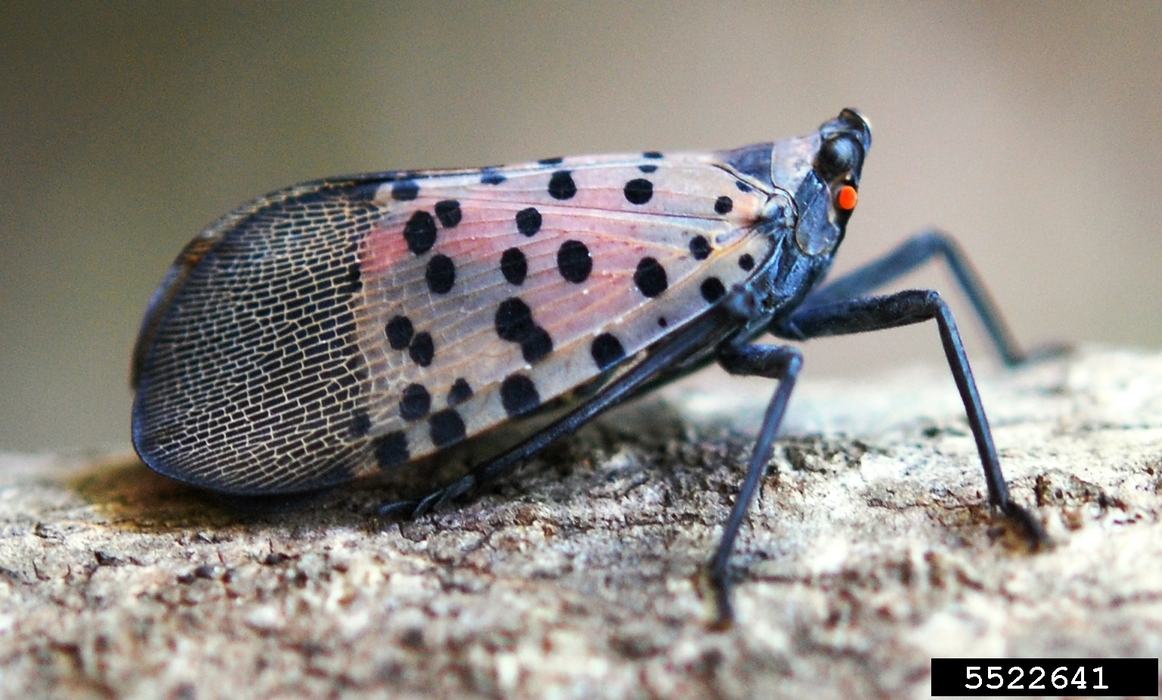
An adult spotted lanternfly in Pennsylvania. Photo by Lawrence Barringer, Pennsylvania Department of Agriculture, Bugwood.org
If you haven't heard of it yet, the Spotted Lanternfly (Lycorma delicatula) is one of the most destructive invasive insect pests threatening the Eastern United States. It hasn’t officially been detected in Lee County yet, but it has steadily been spreading across counties to our north, which means it is likely heading our way.
Understanding what this pest looks like, how it travels, and why it matters to homeowners—not just farmers—is crucial to slowing its spread.
What Is the Spotted Lanternfly and Where Did It Come From?
Despite its name, the spotted lanternfly (SLF) is not a fly or a moth; it is a plant-hopper (order Hemiptera) native to China and Southeast Asia. It uses its special mouthpart, called a proboscis, to suck the juices from plants. Many insects have a narrow preference for certain plants, but the SLF is known to feed on more than 100 species of plants. These include some of our favorite shade trees and fruit trees. The insects exhibit a gregarious behavior, meaning they can gather in large groups and feed as a mass. This can greatly impact the health of plants, especially if the infestation lasts year after year and the plant experiences other environmental stressors.
Who Is Impacted? (It’s Not Just a Farmer’s Problem!)
Spotted lanternflies are aggressive sap-suckers that feed on more than 100 species of trees and plants. Their absolute favorite host is another invasive species, the Tree-of-Heaven (Ailanthus altissima), but they heavily target grapevines, hops, stone fruits (peaches, plums), apples, and hardwood timber. Heavy feeding drains a plant’s energy, stunts growth, and can kill entire vineyards. This puts immense economic pressure on local wineries, craft breweries, orchards, and timber growers.
Even if you don't farm, spotted lanternflies can ruin outdoor living. As thousands of lanternflies feed on shade trees, they excrete massive quantities of a sticky, sugary liquid known as honeydew. This waste coats patios, outdoor furniture, decks, and cars, quickly growing a dark, foul-smelling black sooty mold. To make matters worse, the sugary honeydew attracts predatory wasps, yellowjackets, and ants to your backyard to feed on the insects and the honeydew itself.
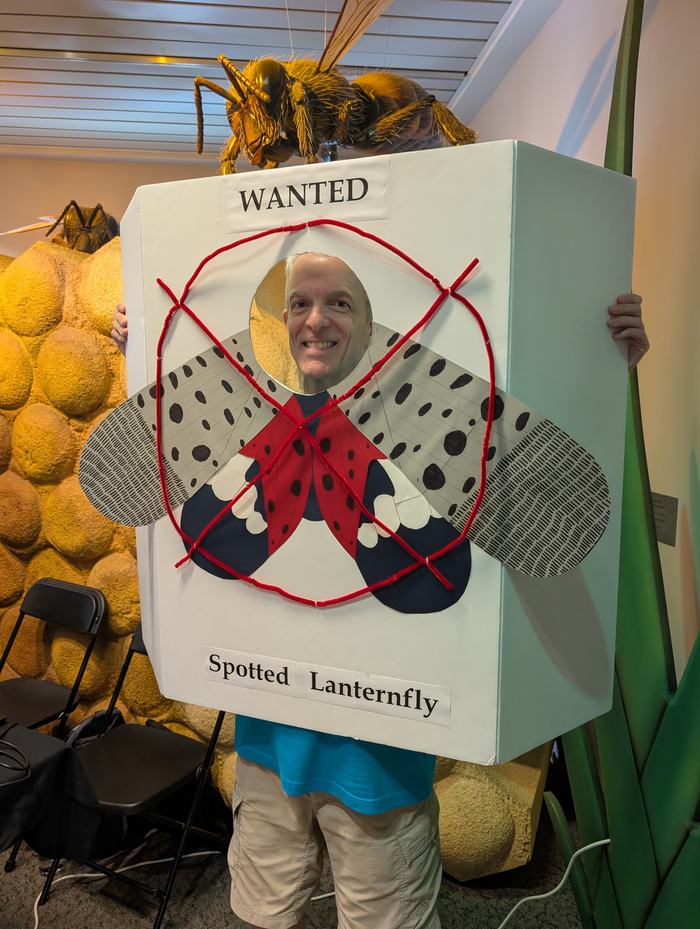
The Center for IPM at NC State University used their booth at BugFest 2026 to raise awareness about the spread of the spotted lanternfly. Center staff developed a photo opp for people to take their picture as the SLF for some fun, but also to make it memorable. Photo by Amanda Bratcher
Where is it now in the US?
It was first detected in the United States in Pennsylvania in 2014, likely arriving as hidden egg masses on international shipments of quarried stone. Because its egg cases look almost identical to dried splotches of mud, they easily blend into rocks, firewood, rusty metal, and vehicle wheel wells. Since its arrival, populations have exploded across the Mid-Atlantic and Northeast, causing severe agricultural losses and suburban property damage. The states where it has been detected are: New Jersey (2018), Virginia (2018), Delaware (2019), West Virginia (2019), Maryland (2019), Connecticut (2019), New York (2020), Ohio (2020), Indiana (2021), and Massachusetts (2021).
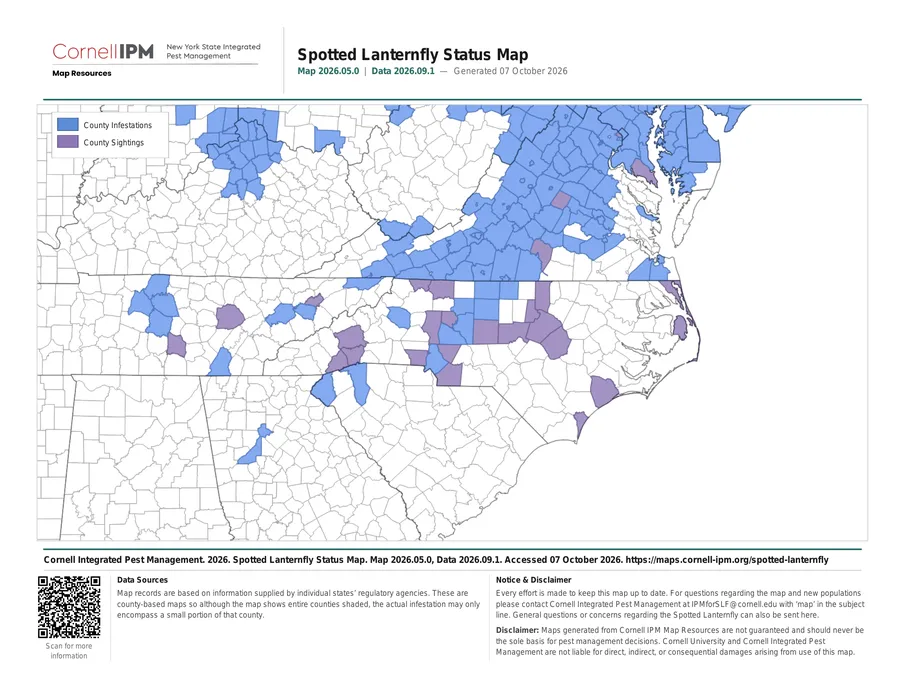
This is a map of the sightings and infestations of the Spotted Lanternfly (SLF) around NC. SLF spread is being tracked by Cornell IPM. An updated map can be found on their website.
Current Status in North Carolina: The US-421 Corridor
Monitoring for spotted lanternfly is led statewide by the North Carolina Department of Agriculture and Consumer Services (NCDA&CS), working in close partnership with N.C. Cooperative Extension specialists, county agents, commercial growers, and vigilant property owners.
NCDA&CS tracks statewide detections closely. The pest was first confirmed in North Carolina in 2022 in Forsyth and Stokes counties. Since then, infestations have crept into several neighboring counties—many of which lie directly along the US-421 corridor, leading straight into Sanford and Lee County!
According to a map from Cornell University’s IPM Center, SLF infestations have been reported in Rockingham, Caswell, Guilford, Davidson, Forsyth, Rowan, Mecklenburg and Caldwell Counties. The NCDA&CS’s Reporting websitereports that the agency is aware of established infestations in Forsyth, Davidson, and Guilford Counties and separates reports from these counties.
The spotted lanternfly has also been sighted in Buncombe, Henderson, Transylvania, Allegany, Surry, Stokes, Iredell, Davie, Gaston, Cabarras, Union, Randolph, Chatham, Wake, Granville, Durham, Johnston, New Hanover, Onslow, Currituck and Dare. We share roads and borders with many of these counties!
Anyone anywhere in NC who thinks they have seen a SLF should report it to the NCDA&CS! Spotted lanternflies are notorious hitchhikers. Adults and egg masses frequently cling to cars, RVs, delivery trucks, and utility trailers parked in infested areas.
A Quick Tip for Travelers: If you travel north or west into counties or states with active spotted lanternfly populations, check your vehicle and gear before returning home. Consider visiting a car wash to power-wash your wheel wells, undercarriage, and truck bed before heading back into Lee County!
What Should You Look For?
Although adult spotted lanternflies look striking in photos, they can be surprisingly elusive in person.
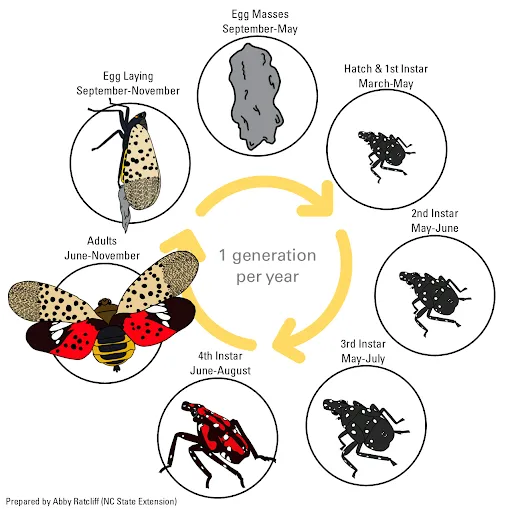
Recognizing them across their different life stages is key:
Egg Masses (Fall through Spring): Female lanternflies lay mud-like splotches on smooth surfaces—including tree trunks, deck railings, outdoor furniture, brick, and cars. Over winter, these masses dry out and look like cracked grey plaster or dried dirt.
Juveniles / Nymphs (Spring and Summer): When eggs hatch in late spring, tiny wingless nymphs emerge. Early-stage nymphs are jet black with bright white spots. By mid-to-late summer, larger nymphs turn a vibrant red and black with white dots.
Adults (Late Summer and Fall): Adult lanternflies are roughly one inch long. At rest, their forewings are a soft grey-brown with black spots and brick-like patterns. When startled or taking flight, they reveal bright red hindwings, a black head, and a yellow-and-black banded abdomen.
The spotted lanternfly undergoes incomplete or gradual metamorphosis. While most of the pictures you see are going to be of the showy adult, you should also be on the lookout of the juveniles. Graphic Developed by Abigail Ratcliff CC BY-ND 4.0
What Should You Do If You See One?
Early detection is our best defense against established infestations. If you suspect you have spotted a lanternfly or its egg mass in Lee County:
Capture a Photo or Specimen: Take a clear, high-quality photo showing the insect's patterns, or carefully collect the insect in a small jar or baggie (you can preserve it in rubbing alcohol or freeze it).
Report It Immediately: Contact the N.C. Cooperative Extension—Lee County Office at 919-775-5624 or submit your sighting directly to the NCDA&CS online reporting portal.
Confirm Before Treating: Proper identification is essential before applying any chemical treatments, as misidentifying native insects can harm beneficial pollinators. If confirmed, NCDA&CS and Extension will guide you through official containment measures.
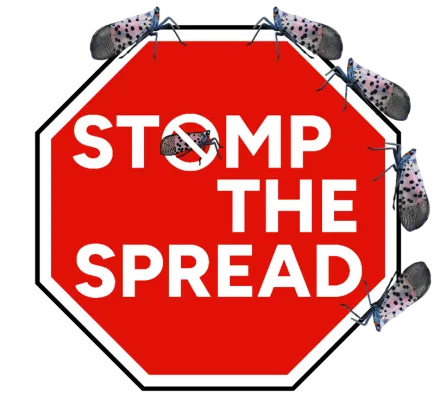
NC Department of Agriculture and Consumer Services started a campaign to empower the public to "Stomp the Spread", to document and then kill the insects before they can spread further. Graphic developed by NCDA&CS
Get In Touch!
Amanda Bratcher is the horticulture agent with N.C. Cooperative Extension—Lee County Center. Have questions about invasive pests, plant identification, or protecting your trees? Reach out to our office at 919-775-5624 or visit our center at 2420 Tramway Road in Sanford.
Find upcoming pest management workshops and community classes on our events page!