Mosquitos cause a lot of anxiety and discomfort as the temperature warms up in the springtime. It is understandable to want to be able to enjoy our outdoor spaces without being mobbed or eaten alive when we walk outside. But there are many other options besides spraying pesticides into your yard to help with your mosquito issue. Not only will you be safer in your own backyard, but you will see more bees, butterflies and lightning bugs too.
Don't want mosquitos this summer? Don't spray your yard!
Research Shows that Yard Sprays Do Not Actually Work Long-Term
Chemical pesticide sprays are a short-term solution to a long-term biological problem. According to Dr. Michael Waldvogel, Associate Extension Professor Emeritus at NC State University, yard sprays are largely ineffective at providing lasting control.
Sprays generally kill only the adult mosquitoes flying through your yard at the moment of application. Because mosquitoes are mobile, new adults from neighboring properties will fly right back into your yard as soon as the chemical dissipates.
Most residential sprays do not reach the hidden standing water where larvae are developing. Unless you stop the "nursery," the next generation is only days away.
Don't fall for the “it's okay because it's a natural or organic chemical”
A few years ago a person knocked on our door on the Fourth of July offering to spray our yard for mosquitos. I wasn’t home at the time, but the person tried to sell us the service because the “chemical was natural and organic”, as if that makes it okay and safe. Not going into the details of whether or not this person even had a pesticide license to do so or even whether it would have been safe to go back into our yard for our barbeque after they sprayed, this was incredibly misleading.
A common sales tactic is to claim a spray is safe because it is "natural" or "organic." In the world of pesticides, these terms can be incredibly misleading. The EPA defines a pesticide by its intent (to kill or repel a pest), not its origin.
Many "organic" mosquito sprays use concentrated botanical oils or pyrethrins. While they come from plants, they are still broad-spectrum insecticides. This means they don't have a "GPS" for mosquitoes; they are just as lethal to the bees pollinating your squash, the butterflies on your zinnias, and the lightning bugs that make North Carolina summers magical.
The Chemical Sprays are Harmful to Beneficial Insects too!
The other danger of chemical pesticide applications is they have the potential to spread beyond your yard. Pesticide applicators are grilled about minimizing drift during their training, and pesticide labels reiterate over and over methods to reduce drift when applying a pesticide.
Your choice to spray often affects your neighbors. A study by the Xerces Society and the University of Nevada found that 100% of yards sprayed by private companies had pyrethroid levels high enough to kill beneficial insects. Shockingly, 75% of neighboring yards—where owners had not requested a spray—were also contaminated due to drift.
So, what DOES work?
If you want to reclaim your yard, you have to shift from "killing adults" to "managing the cycle." Here is how to do it:
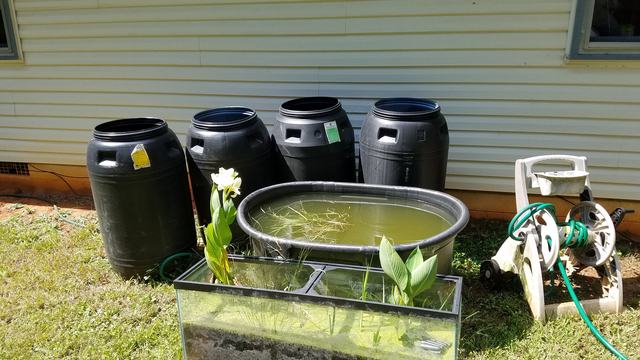
- Tip, Toss, and Dunk: Mosquitoes only need a bottle cap’s worth of water to breed. Every week, walk your property and dump water from saucers, toys, and gutters. For water you can't dump (like rain barrels or birdbaths), use BTI (Bacillus thuringiensis var. israeliensis). This is a naturally occurring bacterium that is highly specific—it kills mosquito and blackfly larvae but is harmless to people, pets, fish, and bees.
- The "Mosquito Bucket" Trap (Ovitrap): This is a brilliant, community-level tool popularized by Homegrown National Park. Fill a five-gallon bucket with water and a handful of straw or dried grass. As the straw decays, it creates a "scent" that female mosquitoes find irresistible for egg-laying. Add a BTI Dunk to the water. The females lay their eggs in your bucket instead of a hidden puddle, and the larvae die as soon as they hatch. You’ve effectively turned your bucket into a "sink" for the local population.
- Personal Protection: Spray yourself, not your yard! Use an EPA-registered repellent containing DEET, Picaridin, or Oil of Lemon Eucalyptus. This creates a "bubble" around you without impacting the fireflies in your grass or the bees in your trees.
What's Best: A Balanced Ecosystem
Ultimately, a healthy yard with a balanced ecosystem is your best defense. When we stop blanket-spraying, we allow populations of dragonflies, birds, and predatory insects to thrive—all of which eat mosquitoes for breakfast.
This year, instead of hiring a mosquito control company, work on controlling standing water on your property, finding a mosquito repellent that works for you, and bolstering your local ecosystem so that when mosquitos do find your yard they get eaten by something else before they eat you!
Contact the NC Cooperative Extension Office in Lee County
Amanda Bratcher is the horticulture agent with N.C. Cooperative Extension- Lee County Center. You can reach out to the office at 919-775-5624 for more information or questions regarding this article, but also any other questions about your garden, farm, land or plants! We’re here to help! You can check out our website's events page for more information and to register for upcoming programs.
This article originally appeared in The Sanford Herald. You can read more articles from the Herald here: https://www.sanfordherald.com/.
Disclaimer Statements
The use of brand names and/or any mention or listing of specific commercial products or services herein is solely for educational purposes and does not imply endorsement by North Carolina State University or our partners, nor discrimination against similar products or services not mentioned.
Recommendations for the use of agricultural chemicals are included in this publication as a convenience to the reader. The use of brand names and any mention or listing of commercial products or services does not imply endorsement by NC State University or N.C. A&T State University, nor discrimination against similar products or services not mentioned. Individuals who use agricultural chemicals are responsible for ensuring that the intended use complies with current regulations and conforms to the product label. Be sure to obtain current information about usage regulations and examine a current product label before applying any chemical. For assistance, contact your local N.C. Cooperative Extension county center.
Resources
National Pesticide Information Center
Bacillus thuringiensis (Bt) Fact Sheet from OSU National Pesticide Information Center
Mosquito Bucket of Doom from Homegrown National Park
Mosquitoes Profile from the National Pesticide Information Center
Mosquito Control Around Homes and in Communities | NC State Extension Publications
Effective Mosquito Management | Xerces Society
Structural Pest Control and Pesticides - Outdoor Pest Control Information | NC Agriculture and Consumer Services
Mosquito Control for Rainwater Harvesting Systems | NC State Extension Publications
Zika Virus & Mosquito Control – More than pesticides | NC Urban Pests
Insect Repellent Guides
Insect Repellent Products | NC State Extension Publications
Insect Repellent Fact Sheet from OSU National Pesticide Information Center
Mosquitos and Pollinators
Study Elucidates Evolution of Mosquitoes and Their Hosts | NC State News
Balancing Beekeeping and Mosquito Abatement in North Carolina - Entomology
An initial assessment of risk to pollinators from mosquito control in residential settings
Join our mailing list!
Enter your email address to receive updates.
Written By